The Regolith Reckoning: Setting a Real Engineering Standard for Lunar Dust
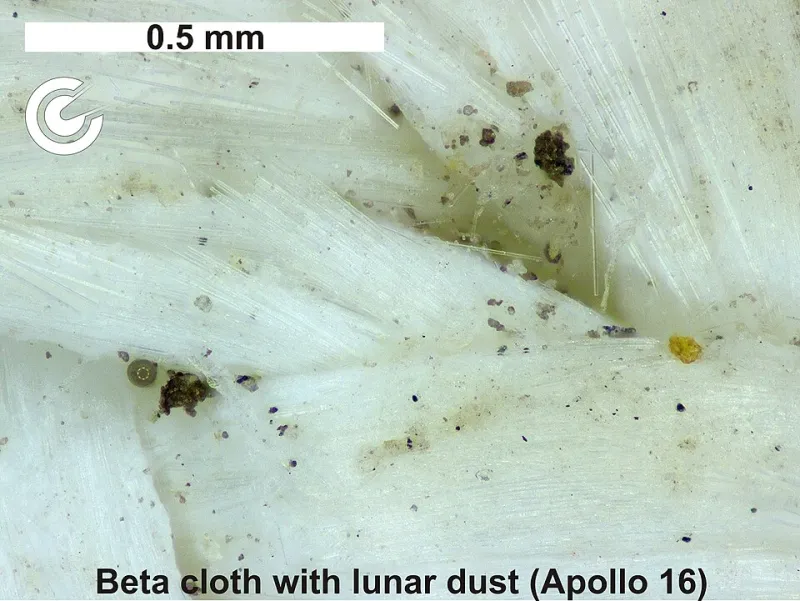
Photo: Meteoriten-Deutschlands, CC BY-SA 4.0, via Wikimedia Commons
Lunar dust has a public-relations problem. It looks like a nuisance — a gray powder to be brushed off a visor — rather than an engineering adversary. But as the United States moves toward sustained lunar surface operations in the late 2020s and beyond, regolith is emerging as one of the most consequential and least funded technical risks. It abrades seals, fouls radiators, clings to suits, contaminates instruments, and finds its way into joints that were never designed to tolerate it. The industry needs to treat lunar dust with the same seriousness that aviation applies to fire codes: not as an afterthought, but as a baseline requirement.
Dust is not dirt
Terrestrial dust has been weathered by water, air, and time. Lunar regolith has not. It is formed by micrometeorite impacts, thermal cycling, and solar radiation in vacuum, producing particles with sharp, glassy edges and a wide range of sizes. It is electrostatically charged by solar ultraviolet and plasma, which makes it cling to surfaces and migrate into crevices. In vacuum, there is no air to suspend it, but there is also no air to clean it away. Once dust enters a mechanism, it tends to stay.
That combination — abrasion, adhesion, and vacuum — makes regolith a systems problem. A dust-tolerant glove is not enough if the wrist bearing ingests grit. A dust-resistant radiator is not enough if the habitat’s airlock tracks jam. The engineering challenge is not a single material or coating. It is the integration of designs, procedures, and verification methods across the entire surface architecture.
Suits and seals are the first line of defense
Planetary suits are the most visible dust interface. Every knee bend, glove flex, and wrist rotation can drive particles into bearings and seals. Dust can obscure visors, degrade thermal coatings, and contaminate the suit’s internal environment when it is brought inside. Future suits will need dust-shedding outer layers, protected joint mechanisms, and cleaning procedures that work in the field rather than only in a laboratory.
Seals are equally critical and less visible. Hatches, sample containers, instrument ports, and docking interfaces all depend on sealing surfaces that must remain clean. A single trapped particle can create a leak path in vacuum or compromise a sample’s integrity. Designers need seal geometries that tolerate some contamination, replaceable sealing elements, and test protocols that use realistic simulants rather than convenient powders.
Habitats, instruments, and maintenance
Surface habitats face dust on every external surface and through every airlock cycle. Radiators lose performance when coated with dust. Solar arrays lose output. Cameras and optical instruments suffer scattered light and scratched apertures. Mechanisms — from robot arms to sample transfer systems — face accelerated wear. Dust also complicates maintenance: every repair becomes a contamination event, and every tool brought outside must be cleaned before it returns.
Mitigation will require a layered approach. Electrostatic cleaning, electrostatic curtains, and dust-tolerant coatings are promising, but they must be proven over repeated cycles. Airlocks need designs that isolate outside contamination from inside habitats. Instruments need replaceable windows, protective shutters, and calibration methods that account for dust accumulation. Operations concepts must include dust budgets — how much contamination is acceptable, where it can accumulate, and how it will be removed.
From simulant to standard
One of the biggest gaps is standardization. Lunar simulants vary widely in composition, particle size, and reactivity. A test that passes with one simulant may fail with another. The community needs reference materials, accepted test methods, and performance metrics that engineers can design against. Dust tolerance should be a requirement in specifications, not a qualitative hope.
The aviation analogy is instructive. Fire codes are not optional design suggestions; they are enforceable standards with test protocols and certification paths. Lunar dust standards should follow a similar logic. That means defining dust exposure environments, establishing pass/fail criteria for seals and mechanisms, requiring contamination budgets for habitats, and creating verification tests that can be repeated across programs. It also means funding the test facilities and simulant production capacity needed to support those standards.
The cost of waiting
Dust mitigation is often deferred because it is not a single impressive technology. It is a thousand small engineering decisions, many of which are easier to make early. Waiting until hardware is built can lock in designs that are difficult to clean, seals that cannot be replaced, and instruments that lose performance after a few weeks. The cost of retrofitting dust tolerance on the Moon will be far higher than designing it in on Earth.
US lunar ambitions depend on more than rockets and landers. They depend on the unglamorous engineering of survival in an abrasive environment. Regolith deserves a standards program, a dedicated research budget, and a place at the table in every surface architecture review. The Moon is not going to become less dusty.