The Helium Ledger: Why a Noble Gas Belongs on the Strategic Materials List
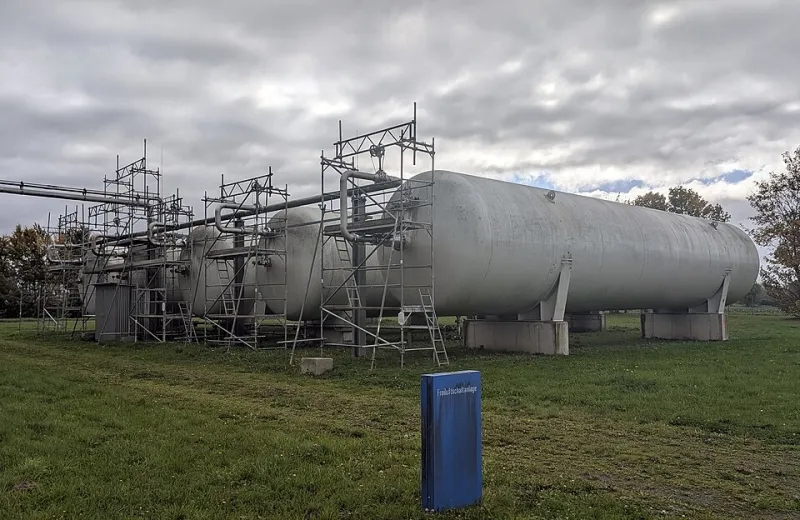
Photo: Siarhei Besarab, CC BY-SA 4.0, via Wikimedia Commons
Helium is the aerospace industry’s invisible utility. It does not appear in marketing brochures, and it rarely appears in boardroom discussions until a delivery is late. Yet it is threaded through launch operations, cryogenic systems, leak detection, welding, and the semiconductor supply chain that underpins modern avionics. As of late 2026, the US helium supply remains structurally fragile: production is concentrated, logistics are specialized, and demand from aerospace, health care, and electronics continues to compete for limited purity grades. Treating helium as a commodity is no longer a defensible posture.
The aerospace dependency map
On a launch pad, helium purges lines before cryogenic propellants flow and helps maintain clean, dry conditions in systems that cannot tolerate moisture or air. In cryogenic applications, it is used for pressurization and cooling where its low boiling point and inertness are valuable. Leak detection depends on helium’s small molecule and low background in many environments. Aviation maintenance and component manufacturing use helium-based leak testing for fuel systems, hydraulic components, and sealed assemblies. Semiconductor fabrication, which supplies the chips in every modern aircraft and spacecraft, also relies on helium for cooling and process control.
That dependency map matters because helium is not evenly substitutable. Nitrogen can replace helium in some purge operations, but not all. Argon can serve some shielding roles, but not cryogenic cooling. Hydrogen is flammable and brings its own safety requirements. Alternative leak-detection tracers exist, but they require qualification and may be less sensitive. Every substitution is an engineering project, not a purchasing decision.
A fragile supply chain
Helium is primarily a byproduct of natural gas processing. It is extracted where gas composition and plant economics allow, then purified, liquefied, and transported in specialized containers. The number of large-scale production sites is small, and several are outside the United States. Domestic supply has been shaped by the federal helium reserve’s long disposal path, private extraction economics, and the practical difficulty of building new helium plants. When a plant goes offline for maintenance, the effect can be felt across the supply chain for months.
Transport adds another layer of risk. Liquid helium must be kept extremely cold, and storage boils off over time. Delivery schedules are sensitive to distance, container availability, and port or rail disruptions. For aerospace firms, the result is a material that is essential, hard to store long-term, and exposed to events far outside their control.
Recovery is an engineering problem
The most immediate resilience strategy is recovery. Much of the helium used in purges and leak detection is vented to atmosphere, often at low concentration. Capturing that helium requires careful system design: dedicated return lines, membranes or pressure-swing adsorption for concentration, liquefaction or compression for storage, and quality control to ensure the recovered gas meets specification. The economics vary by site, but launch complexes, large test stands, and semiconductor facilities are natural candidates because they use significant volumes in concentrated locations.
Recovery also requires a cultural shift. Helium must be designed into facility layouts as a loop, not a one-way utility. Operators need training, instrumentation, and maintenance procedures for recovery equipment. Contracts need to value recovered gas and account for its purity. The alternative — treating vented helium as free — is an accounting fiction that becomes expensive during shortages.
Substitution and demand reduction
Substitution should be pursued where it is technically sound, but it will not solve the problem alone. Some purge operations can use nitrogen with appropriate drying and monitoring. Some leak tests can use alternative tracers after validation. Cryogenic applications are harder to change. The most reliable near-term lever is demand reduction: optimizing purge volumes, fixing leaks in helium systems, improving recovery rates, and scheduling operations to avoid unnecessary venting.
Aerospace firms should also map their helium use by criticality. Not every application needs the same purity or the same volume. Separating critical uses from discretionary ones allows better allocation during shortages and helps engineering teams prioritize substitution and recovery investments.
A strategic materials playbook
Helium belongs on the strategic materials list because the aerospace base cannot function without it. A serious playbook would include strategic inventory and contracts that reflect supply risk, federal coordination on helium production and storage, recycling incentives, standards for recovered helium purity, and research into lower-consumption processes. It would also require better data: how much helium does the US aerospace sector use, where, and at what criticality?
None of this is glamorous. But the alternative is a repeat of familiar shortages: rising prices, delayed tests, and engineering teams scrambling for a gas that most people never think about. Helium is not just a commodity. It is infrastructure, and it should be managed like one.