Downlink Defense: The Unseen Infrastructure Holding America’s Space Ambitions Together
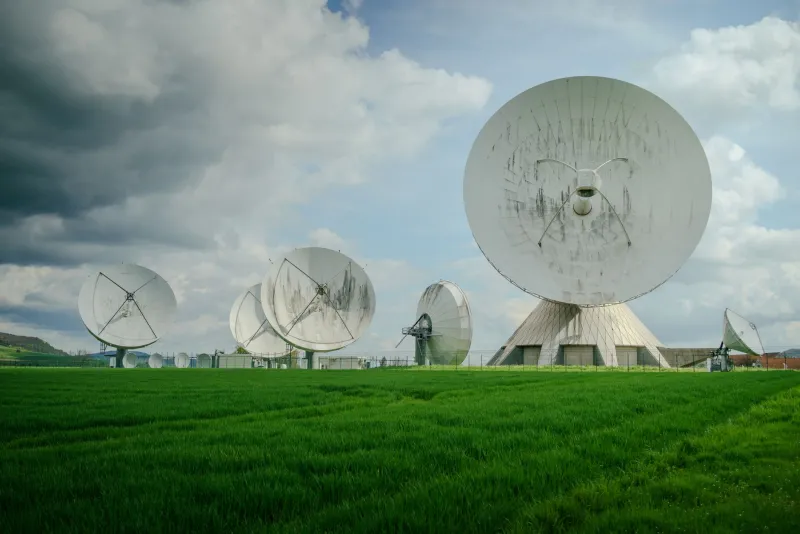
A rocket leaving Vandenberg or Cape Canaveral is a visible expression of national capability. The less visible expression sits in concrete pads, fiber routes, modems, spectrum licenses, cloud regions, and security operations centers scattered across the United States and its partner networks. That is the ground segment, and it is where many space missions now succeed or fail.
The point is not that boosters and satellites are unimportant. It is that the balance of risk has shifted. A constellation can be launched on schedule and still be constrained by antenna availability, downlink congestion, licensing delays, or a cyber incident in a mission operations center. As US civil, commercial, and national security space programs push toward greater launch cadence and more distributed architectures, the ground segment is becoming a strategic bottleneck rather than a back-office utility.
The Ground Segment Is the Mission System
Ground segment once meant a dedicated dish, a controlled facility, and a closed network. That model still exists for high-value missions, but it is no longer the whole picture. Modern architectures depend on shared teleports, ground-station-as-a-service providers, optical terminals, commercial cloud processing, and interoperable mission operations software. The ground segment is less a place than a chain of trust and timing.
That chain has several links. Antennas and radio frequency front ends must be available when satellites pass overhead. Spectrum must be coordinated and protected. Data must move over terrestrial fiber without unacceptable latency. Processing must turn raw downlink into usable products. Cybersecurity must protect command paths, telemetry, and customer data. Each link can be redundant in theory and fragile in practice.
Commercial Capacity, Government Demand
The US government has been moving toward greater use of commercial ground services, particularly for missions that do not require dedicated government-owned infrastructure. NASA’s communications networks have explored commercial augmentation for near-Earth operations, while the Space Force has signaled interest in buying ground-segment capacity as a service rather than owning every antenna and modem.
The logic is familiar from launch and satellite manufacturing. Commercial providers can spread capital costs across many customers, refresh technology more quickly, and offer geographic diversity that a single agency cannot easily replicate. For civil science missions, commercial ground stations can fill gaps in coverage. For national security missions, they can add surge capacity and alternate paths.
The risk is dependency without assurance. A service-level agreement is not the same as a dedicated mission assurance program. Government buyers must be able to verify security controls, understand outage reporting, and exercise contingency operations. The procurement question is not simply whether to buy commercial. It is how to buy commercial capacity while retaining the ability to direct, protect, and reconstitute it.
Spectrum and Interference
Spectrum access is the quiet constraint. Ka-band and Ku-band links remain workhorses for many missions, while optical communications promise higher throughput and lower interception risk. Neither escape physics or regulation. Radio links require coordination and interference protection. Optical links require clear weather and precise pointing, which makes ground-site diversity important.
The Federal Communications Commission and the International Telecommunication Union set parts of the framework, but operators still face practical coordination challenges. As more constellations share the same bands, interference becomes a scheduling and engineering problem as much as a legal one. Ground operators need better tools for dynamic spectrum management, interference detection, and cross-operator coordination.
Cloud Processing and Cybersecurity
Moving mission data into commercial cloud environments can accelerate processing and make data accessible to more users. It also expands the attack surface. A ground station is a physical asset; a cloud-based mission operations environment is a distributed system with identity management, application programming interfaces, and supply-chain dependencies.
Zero-trust architecture, encrypted command links, and strict separation between administrative and mission networks are necessary but not sufficient. The ground segment must be designed for degraded operations. What happens when a primary cloud region is unavailable? How quickly can a backup antenna be tasked? Can operators authenticate commands without the primary identity provider? These are engineering questions with procurement consequences.
Redundancy Is a Procurement Problem
Geographic diversity is the simplest form of resilience. A site in Alaska, a site in the continental United States, and a partner site overseas do not experience the same weather, power grid, or fiber route. But diversity costs money, and traditional procurement often rewards lowest-cost compliant bids rather than demonstrated resilience.
A more resilient approach would treat ground services as a portfolio. Buyers could require minimum numbers of independent paths, published outage metrics, exercised failover procedures, and security assessments that go beyond checkbox compliance. Contracts could include incentives for rapid reconstitution and penalties for undisclosed subcontractor dependencies.
What Would Change the Curve
Three changes would help. First, common interfaces and data standards would make it easier to shift traffic between providers. Second, regular multi-provider exercises would test the ground chain under realistic stress, not just on paper. Third, the workforce pipeline for radio frequency engineers, network security specialists, and mission operations staff needs sustained attention.
The United States does not lack antenna capacity in every band or every region. It lacks a consistently assured, interoperable, and exercisable ground architecture. That is a less glamorous problem than a new booster, but it is just as consequential. The next era of US space ambition will be limited not only by what can be launched, but by what can be heard, protected, and turned into decisions on the ground.