The Unseen Chokepoints: America’s Aerospace Supply Chain Runs on Small Parts

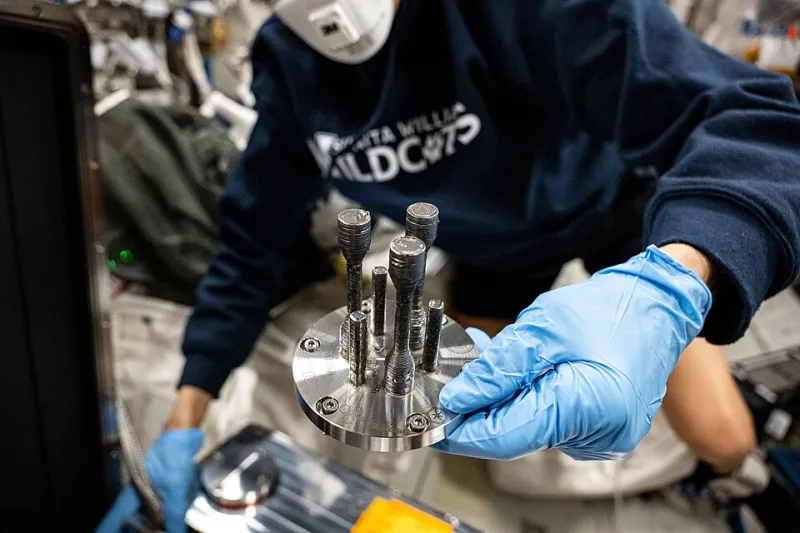
Photo: aerospace fasteners bearings precision components cleanroom manufacturing, via custommaterials.com
American aerospace has a habit of celebrating the visible. Engines, avionics, composite wings, and reusable boosters command attention because they are complex, expensive, and legible to the public. But the schedule risk often lives in bins of fasteners, boxes of seals, and drawers of connectors that cost less than the paperwork required to qualify them. The small-parts supply chain is where engineering ambition meets industrial reality, and in 2026 that reality is increasingly fragile.
The tyranny of the qualified part
An aerospace fastener is not a hardware-store bolt. It is a controlled artifact with a pedigree: alloy chemistry, heat treat, plating, thread tolerances, lot traceability, and a qualification path tied to a specific drawing and process. A bearing may carry decades of service history in one aircraft platform but still require a new qualification campaign before it can be used in another. Seals and connectors face similar constraints. The result is a paradox: the parts that are cheapest to make are often the most expensive to replace, because the cost is not in the metal or polymer but in the evidence that the part is acceptable.
That evidence burden is necessary. It is also a bottleneck. When a sole-source supplier exits the market, a qualified alternate does not simply appear. Engineers must identify a candidate, run environmental and fatigue testing, audit the process, update drawings and planning documents, and persuade the customer — often a prime contractor or a government program office — that the change is safe. For a satellite or a crewed vehicle, that process can take years. For a legacy aircraft, it can outlast the platform itself.
Consolidation and the counterfeit paradox
Over the past two decades, the small-parts tier has consolidated. Private equity rollups, family-business retirements, and the economics of low-volume aerospace work have pushed many niche suppliers into larger groups or out of the market entirely. The remaining suppliers often serve multiple primes, which improves utilization but concentrates risk. A fire, a labor dispute, or a single failed audit at one plant can ripple across commercial aircraft, defense programs, and civil space simultaneously.
Counterfeit-risk controls make the problem harder. Aerospace firms must verify provenance, test incoming lots, and maintain chain-of-custody records for parts that may have passed through several distributors. Those controls are essential — counterfeit fasteners and bearings have no place in flight hardware — but they also raise the cost of switching suppliers. A new entrant may be technically capable and still fail the audit burden. The industry has responded with digital traceability and expanded testing, yet the net effect is a supply base that is safer but narrower.
Where the bottlenecks bite
The bottlenecks are not evenly distributed. High-temperature bearings for engine accessories and spacecraft mechanisms depend on a small number of specialized manufacturers. Aircraft seals must survive hydraulic fluid, ozone, and temperature cycles, and their qualification often relies on proprietary compounds. Mil-spec connectors and backshells are vulnerable to plating and insert shortages. Titanium and specialty-alloy fasteners face long lead times when mill capacity tightens. Launch vehicles add another layer: purge fittings, cryogenic seals, and precision valves must meet schedules that leave little room for requalification.
These parts are also difficult to stockpile intelligently. A warehouse full of fasteners is not resilience if the parts are the wrong alloy, the wrong finish, or the wrong revision. Effective inventory requires engineering data as much as shelf space. Program offices need to know which parts are truly interchangeable, which require revalidation, and which are locked to a single process. That mapping is often incomplete.
A resilience agenda for small parts
A more resilient industrial base will not emerge from标语 or from stockpiling alone. It requires strategic mapping of single-source and sole-source parts across civil and defense portfolios, with shared visibility between primes and government. It requires qualification reform that preserves safety while allowing faster adoption of qualified alternates, including modular test campaigns and accepted industry-wide data. It requires investment in shared test infrastructure so that small suppliers can prove their parts without building laboratories they cannot afford. And it requires workforce development for the machinists, heat treaters, plating specialists, and quality engineers who make the small-parts tier work.
The US aerospace system is still capable of extraordinary things. But its ability to deliver on time increasingly depends on whether a bearing plant in the Midwest, a seal compounder in New England, and a connector plater in the Southwest can all keep running. The visible programs will continue to draw attention. The invisible chokepoints deserve the same seriousness.