Melt, Deposit, Qualify: The Real Bottleneck in 3D-Printed Rocket Engines
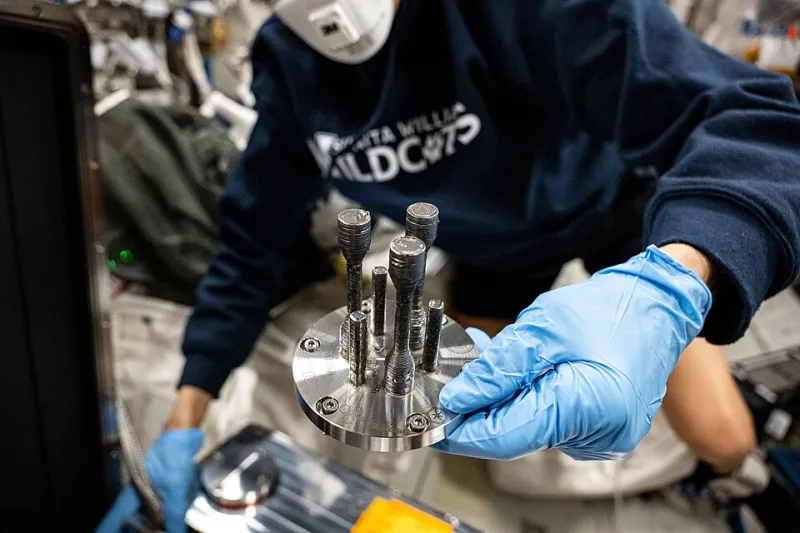
Photo: NASA Johnson Space Center, Public domain, via Wikimedia Commons
A rocket engine is an unforgiving test of manufacturing. It combines extreme heat, cryogenic propellants, high-pressure plumbing, and tolerances that leave little room for variation. Additive manufacturing has earned a place in that environment because it can consolidate parts, shorten lead times, and create cooling geometries that conventional machining struggles to produce. The question for the US propulsion industrial base is no longer whether printing works. It is whether printing can be qualified and scaled with the discipline a flight-critical supply chain requires.
From Prototype to Flight Critical
The shift is visible across the industry. Laser powder bed fusion has moved from brackets and prototype manifolds into injectors, combustion chambers, and regeneratively cooled thrust chambers. Directed energy deposition is used for near-net-shape structures and repair. Copper alloys such as GRCop-42 and GRCop-84 have become familiar names in chamber design, while nickel-based superalloys remain common in high-temperature sections.
The engineering appeal is straightforward. An injector that once required dozens of brazed or welded details can be printed as a smaller number of consolidated pieces. A chamber with intricate cooling channels can be built layer by layer rather than assembled from tubes. Fewer joints can mean fewer leak paths and shorter schedules. For small launch companies and responsive space concepts, those advantages are substantial.
Where Printing Pays
Additive manufacturing pays best when it removes assembly complexity, shortens the path from design to test, or enables a geometry that cannot be made otherwise. It pays less well when it is used simply to reproduce a conventional part with a slower process and a more complicated inspection burden.
The strongest cases tend to involve integrated fluid passages, thin-walled structures, and low-volume parts with high geometric complexity. Injector heads, cooling jackets, and compact manifolds fit that profile. Large simple structures may still be faster and cheaper with conventional forming and machining. A healthy industrial base will use additive where it genuinely adds value rather than treating it as a branding exercise.
The Qualification Tax
Qualification is where the optimism meets the metallurgy. A printed part is not automatically equivalent to a wrought or cast part, even when the alloy designation matches. Microstructure, porosity, residual stress, surface roughness, and build orientation all affect performance. The process is the material.
That means qualification cannot rest on a single successful build. It requires a control plan for powder chemistry, particle size distribution, reuse limits, laser parameters, build atmosphere, post-processing, and heat treatment. It requires mechanical test coupons that represent the actual build. It requires nondestructive evaluation that can detect defects which may be small, irregular, or oriented in ways that conventional inspection struggles to characterize.
Computed tomography has become a powerful tool, but it is not a universal answer. It can be slow, expensive, and limited by part geometry and density. Surface inspection, ultrasonic methods, and destructive sectioning still matter. The qualification tax is not a reason to avoid additive manufacturing. It is the price of using it responsibly.
Powder, Parameters, and People
Powder feedstock is a supply chain in its own right. Aerospace-grade powder must be qualified, handled, stored, and often reused within validated limits. Contamination or inconsistent particle size can change flowability and melt behavior. For copper alloys, oxygen content and thermal conductivity add further complexity.
Machine parameters are equally sensitive. A process developed on one laser powder bed system may not transfer directly to another, even within the same model family. Parameter sets must be qualified for the material, geometry, and machine. Production control then depends on monitoring layer quality, melt pool behavior, and build logs.
The workforce challenge is underappreciated. Additive manufacturing needs engineers who understand both design for additive and traditional propulsion fundamentals. It needs machine operators who can recognize drift before a build fails. It needs inspectors who can interpret volumetric data and metallurgists who can connect microstructure to flight performance. Those skills are not produced by a single training course.
Scaling Without Skipping Steps
As US launch providers and defense programs seek higher cadence, additive manufacturing will be pressed to scale. The danger is that scaling becomes a race to skip the unglamorous work: statistical process control, supplier audits, traceability, and failure analysis. The industrial base that wins will not be the one that prints the most exotic part. It will be the one that can prove, lot after lot, that the part behaves as predicted.
There is a constructive path. Common material databases, shared qualification standards, and better in-process monitoring can reduce redundant effort without lowering the bar. Government and industry can collaborate on pre-competitive research into inspection methods and allowables. Primes can treat additive suppliers as process-critical partners rather than job shops.
Additive manufacturing has already changed what is possible in rocket propulsion. The next phase is less about possibility and more about reliability. The companies that master qualification will determine whether printing remains a specialist advantage or becomes a durable foundation for the US propulsion supply chain.