Stronger, Lighter, Cheaper: The Composite Materials Quietly Transforming Aircraft Economics
For decades, aluminum was the undisputed backbone of aerospace manufacturing. Its combination of workability, strength, and relative affordability made it the default choice for engineers designing everything from regional turboprops to wide-body intercontinental jets. That era is not ending — but it is being profoundly reshaped. Advanced composite materials, once reserved for high-budget defense programs and racing applications, have matured into a commercially viable engineering staple, and their influence on aircraft durability, maintenance schedules, and fleet economics is growing more significant with each new aircraft program.
The shift is not merely about weight reduction, though that benefit remains substantial. The deeper transformation is economic. Composites corrode differently than metals — in many cases, they do not corrode at all in the conventional sense — and their fatigue characteristics under cyclic loading offer fleet operators a compelling argument for longer inspection intervals and reduced unscheduled maintenance events.
From Defense Labs to Commercial Flightlines
The lineage of aerospace composites traces back to military research in the 1960s and 1970s, when carbon fiber reinforced polymers first demonstrated structural promise in fighter aircraft components. Programs like the F-14 Tomcat and later the B-2 Spirit leveraged composites aggressively, accepting higher per-pound material costs in exchange for performance advantages that justified the investment in a defense context.
Commercial aviation's adoption was more cautious. The Boeing 787 Dreamliner, which entered service in 2011, represented the industry's most visible inflection point: approximately 50 percent of its structural weight derives from composite materials, including the fuselage barrel sections — a design decision that Boeing projected would reduce airframe maintenance costs by roughly 30 percent compared to conventional aluminum construction.
More than a decade of 787 operational data has largely validated that projection. Airlines operating the aircraft have reported fewer corrosion-related inspections and, in many cases, extended heavy maintenance intervals compared to earlier-generation widebody platforms. The data has not gone unnoticed by program planners at Airbus, Embraer, and across the US defense industrial base.
What the Materials Actually Do Differently
Understanding why composites alter maintenance economics requires a brief look at the material behavior itself. Carbon fiber reinforced polymer, or CFRP, consists of carbon fiber strands embedded within a resin matrix — typically epoxy. The resulting structure is anisotropic, meaning its mechanical properties vary by direction, which allows engineers to optimize layup orientations for specific load paths. This design flexibility is something metallic structures cannot easily replicate.
Critically, CFRP does not undergo the same electrochemical corrosion processes that afflict aluminum and steel. In environments where moisture, salt air, and de-icing chemicals accelerate metallic degradation — conditions common across US coastal operating environments and northern hub airports — composites maintain structural integrity without the surface treatments, primer coatings, and periodic inspection regimes that metallic airframes demand.
Fatigue behavior also differs substantially. Metals accumulate fatigue damage in a relatively predictable, linear fashion under cyclic stress, which underpins the established damage-tolerance frameworks that govern metal airframe inspection intervals. Composites exhibit different failure modes — delamination, matrix cracking, fiber breakage — that require updated inspection methodologies, including ultrasonic testing and thermographic imaging. The initial investment in those inspection capabilities is real, but the intervals between required inspections can be significantly longer, reducing the frequency with which aircraft must be pulled from revenue service.
The Urban Air Mobility Dimension
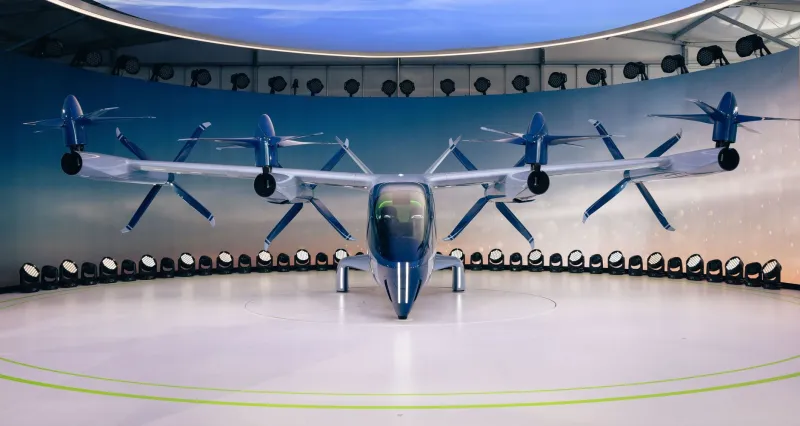
The implications extend well beyond legacy commercial aviation. The emerging urban air mobility sector — electric vertical takeoff and landing aircraft, advanced air taxis, and regional electric aircraft — is being designed almost entirely around composite structures from the outset. Companies including Joby Aviation, Archer Aviation, and Wisk Aero, all operating within the US market, have made CFRP and related materials central to their airframe architectures.
For eVTOL platforms, the case for composites is particularly compelling. These aircraft are designed for high-cycle operations — potentially dozens of flights per day in urban corridors — placing exceptional demands on structural fatigue life. The ability to engineer composite layups that resist fatigue accumulation over tens of thousands of cycles, combined with the weight savings that directly extend electric range, makes the material choice effectively non-negotiable for competitive designs.
Materials engineers working on next-generation eVTOL platforms have noted that composites also offer manufacturing advantages relevant to the scale of production urban air mobility requires. Automated fiber placement and resin transfer molding processes, increasingly mature in the US aerospace supply chain, allow complex structural components to be produced with high repeatability and relatively low per-unit labor content at volume — a critical factor for companies aiming to make urban air mobility economically accessible.
The Cost Calculus for Fleet Operators
Translating material science into fleet economics requires looking beyond the aircraft acquisition price. Composite-intensive airframes typically carry higher upfront manufacturing costs — carbon fiber remains more expensive per pound than aerospace-grade aluminum — but that premium is increasingly offset by lifecycle savings that accrue over the operational period.
Maintenance cost modeling conducted across several US airline programs has suggested that composite primary structures can reduce direct maintenance costs by 15 to 25 percent over a 20-year operational life, depending on route environment and aircraft utilization rates. The largest savings tend to appear in labor hours associated with corrosion inspection and treatment, structural repair frequency, and the reduced need for heavy airframe checks driven by corrosion findings.
There are countervailing considerations. Composite repair requires specialized technicians and equipment not universally available across the US maintenance, repair, and overhaul network. A damaged composite panel cannot simply be straightened and re-primed the way a dented aluminum skin can be addressed. Delamination damage may be invisible to the naked eye, requiring investment in non-destructive inspection tooling. The FAA's regulatory framework for composite repair continues to evolve, and operators must ensure their maintenance personnel hold appropriate training and certification for the specific composite systems in their fleets.
A Material Foundation for Sustainable Aviation
The sustainability dimension of composites deserves acknowledgment, though it is not without complexity. The weight reductions composites enable directly translate to fuel burn reductions — and in the near term, fuel burn reduction remains the most impactful lever available to the commercial aviation industry for reducing its carbon footprint. A lighter airframe burns less fuel per seat-mile, a relationship that scales significantly across large fleets operating high-frequency routes.
The end-of-life challenge for CFRP is more complicated. Carbon fiber is difficult to recycle in a manner that recovers fiber properties suitable for structural re-use, and current recycling processes predominantly produce shorter, lower-grade fibers suitable for non-structural applications. Research programs at several US universities and national laboratories are actively developing improved recycling methodologies, and some industry analysts project commercially viable structural-grade CFRP recycling within the next decade.
The trajectory of composite adoption in aerospace is not a question of whether but of how fast. As automated manufacturing processes reduce production costs, as the US MRO network builds deeper composite repair expertise, and as eVTOL platforms enter commercial service at scale, the economic and engineering case for advanced composites will only strengthen. The revolution may be quiet — composites do not announce themselves the way a new engine architecture does — but its consequences for how America flies, and at what cost, are anything but subtle.